
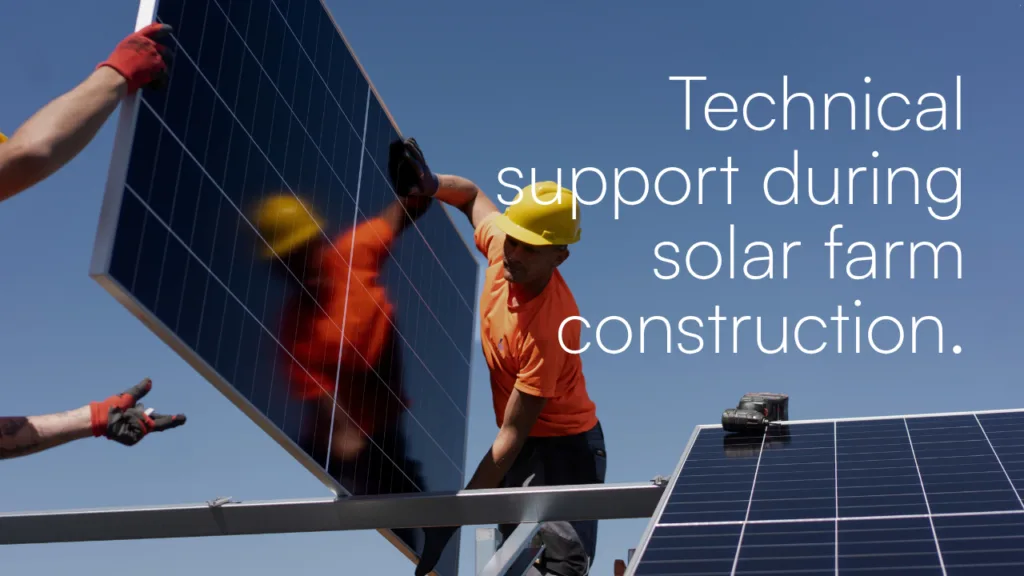
Technical support during solar farm construction. Why a good mounting structure is only the beginning
Technical support during solar farm construction helps translate the structural design into correct installation on site.
Depending on the project, ENSON supports EPC teams through installation training, ongoing technical consultations, clarification of documentation and structural details, as well as partial and final inspections.
The goal is to identify questions and potential non-conformities as early as possible, before they are repeated across subsequent sections of the solar farm and begin to affect the progress of the works.
Cooperation starts before the structure reaches the site
On a utility-scale PV project, supplying the mounting structure is not the end of the manufacturer’s role.
Many decisions that later affect installation are made much earlier. That is why we begin working with investors and EPC contractors already at the project preparation stage.
We analyse project assumptions, consult technical solutions and look at the mounting structure not only from the perspective of engineering calculations or manufacturing. How the system will later be delivered, installed and used on site matters just as much.
For the investor, safety, cost and project predictability are important. For the EPC contractor, repeatable installation, clear documentation and fast access to technical support also matter.
These requirements are best considered before installation begins.
Good installation starts with preparation
Even a well-known mounting system requires the installation team to be prepared for the specifics of a particular project.
Depending on the scale, complexity and technical requirements of the investment, we can provide installation training before the main works begin.
During the training, we cover:
- the structure and its key components,
- the installation sequence,
- the correct installation of individual components,
- points that require particular attention,
- requirements included in the technical documentation.
The purpose of the training is not to replace the contractor’s experience. It is to make sure the team understands the solutions used in the specific project and can install the structure correctly from the start.
This is particularly important on large projects, where one incorrectly interpreted detail can be repeated across multiple tables and later require a much broader scope of corrections.
Technical support during installation
Questions may arise on site that could not have been fully anticipated at the design stage.
They may relate to documentation, a specific structural detail, the installation method or conditions encountered on site. In these situations, fast access to the right information matters.
That is why, when a project requires it, we remain in contact with the client and the installation team throughout execution. The ENSON team can review the issue, check the documentation and, where necessary, consult the solution with our engineers.
On a large project, even a minor installation error or incorrect interpretation of the documentation can lead to corrections at later stages. The later an issue is identified, the greater the scope of work required to resolve it may become.
Technical questions are therefore best clarified as they arise, before they begin to affect the pace of subsequent works.
Partial inspections: checking the work while the project is still in progress
For larger projects, we also carry out partial inspections. The idea is simple: selected elements are checked during execution rather than only after the entire structure has been completed.
Depending on the project, the inspection may include:
- compliance with the technical documentation,
- key installation points,
- selected dimensions and structural geometry,
- correct execution of the elements covered by the inspection.
If a non-conformity appears, it can be identified before the same installation method is repeated across subsequent sections of the solar farm.
This is particularly important in utility-scale projects, where the same structural detail may appear hundreds or thousands of times. An early correction helps limit the scope of later rework.
Final acceptance of the PV mounting structure
Once installation is complete, we carry out final acceptance within the scope of the ENSON system.
We verify that the installed structure complies with the technical documentation and that the works covered by the acceptance process have been completed.
This closes the execution stage, but not the exchange of information. After the works are completed, we discuss the project with the client and contractor, collect feedback from the site and pass it on to our technical team.
That feedback may relate to the structure itself, the documentation, the sequence of works or the way the project was prepared for installation. We use these observations in future projects.
Engineering does not end with the technical drawing
A mounting structure first exists in calculations and technical documentation, but the construction site is where the solution is tested in practice.
Is the documentation clear for the installer?
Is the installation process repeatable?
Do the structural details work well under real project conditions?
These are not questions that should be separated from the engineering process.
That is why feedback from the construction site returns to our engineering team and can influence future projects, documentation and the way installation is prepared.
This is the basis of our Mindful Design approach: engineering with the entire execution process in mind, not just the structure itself.
From engineering to execution. And back.
What does this support mean for the investor and EPC contractor?
Technical support from the structure manufacturer does not replace the contractor’s responsibility for installation. Its role is to provide access to project-specific knowledge when it is needed on site.
In practice, this can mean:
- better preparation of the installation team before works begin,
- faster clarification of technical questions,
- earlier identification of potential non-conformities,
- lower risk of repeating installation errors,
- more efficient communication between the construction site and the technical team,
- verification of the structure at different stages of execution.
The earlier the cooperation model is agreed, the easier it is to respond to technical issues during construction.
The scope of technical support should be agreed before installation begins
There is no single support model that fits every project.
The scope depends, among other things, on the scale of the investment, its complexity, the experience of the installation team and the mounting system used.
Before installation begins, it is therefore worth defining:
- whether installation training is required,
- who the technical contact on the manufacturer’s side will be,
- how questions from the construction site will be reported,
- whether partial inspections are planned,
- how final acceptance will be carried out.
A well-prepared cooperation process makes the transition from design to installation smoother and allows technical questions to be addressed more quickly when they arise.
If you’d like to learn more about how we operate, read this post and watch the video, in which our Post-sales service engineer explains more about this topic.
AI tools were used to support the editorial process in preparing this material. The ENSON team is responsible for verifying the content and approving the final version.