
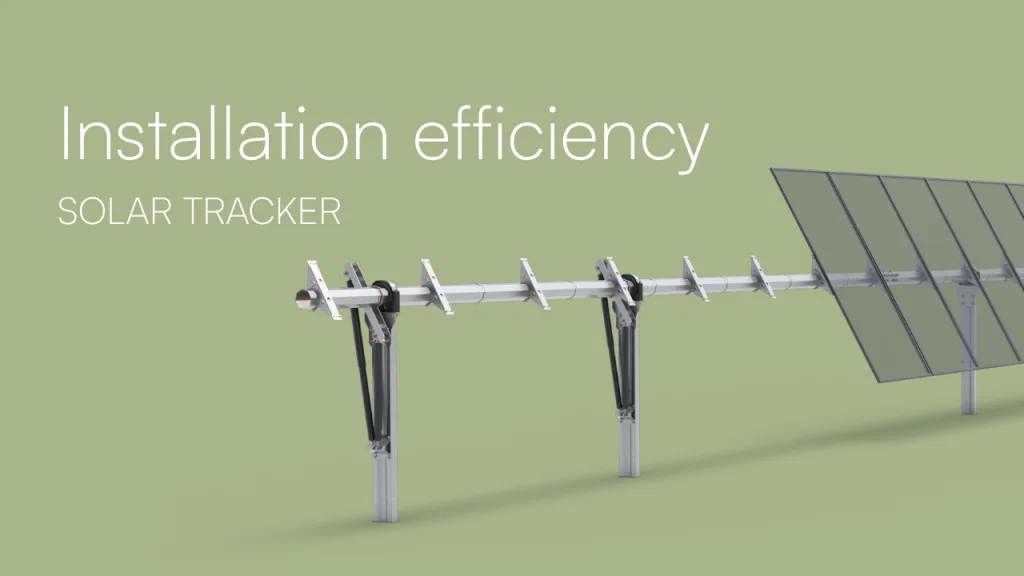
Solar tracker installation efficiency: what actually matters on site
Most conversations about solar trackers begin with energy yield. Higher production, stronger project economics and improved IRR tend to dominate the evaluation.
Yet before a tracker generates its first additional kilowatt-hour, it must be delivered, assembled, aligned, wired and commissioned across hundreds or thousands of repeated installation points.
This is where design assumptions meet real site conditions — and where the constructability of a tracking system begins to affect labour, quality control, installation consistency and the project schedule.
At ENSON, we develop mounting structures and single-axis tracking systems for utility-scale PV projects from the perspective of the teams that will work with them on site: EPC contractors, installation crews and project managers operating against defined milestones.
For this reason, efficient solar tracker installation was not treated as a separate add-on during product development. It formed part of the engineering brief from the beginning.
Two details illustrate this approach particularly well: organised cable routing and project-specific module fixing.
Why tracker design affects installation efficiency
A single-axis tracker is both a structural system and a moving mechanical system. Its components must be assembled repeatedly across the site while maintaining the geometry, clearances and connection quality required for reliable operation.
For an EPC contractor, installation efficiency therefore means more than completing individual tasks quickly. It also depends on:
- repeating the same process consistently across tracker rows;
- limiting site-specific workarounds;
- reducing the number of decisions left to installation crews;
- maintaining access for inspection and quality control;
- coordinating structural, mechanical and electrical work;
- avoiding installation details that may create future O&M issues.
A detail that appears minor on one tracker row can become a significant operational issue when repeated across a utility-scale solar farm.
The objective is not simply to remove installation steps. It is to make each step clear, repeatable and compatible with the project requirements.
Solar tracker cable management designed into the structure
Cable management is a recurring challenge in single-axis tracker installation.
Cables must follow the tracker geometry, accommodate its range of movement and remain protected from clashes, excessive bending and mechanical wear. They must also interact safely with bearings, the motor and other moving or structural components.
When cable routes are not defined at the design stage, installation crews may need to determine them row by row. Even when the resulting solution works, it can produce inconsistencies across the site and make quality control more difficult.
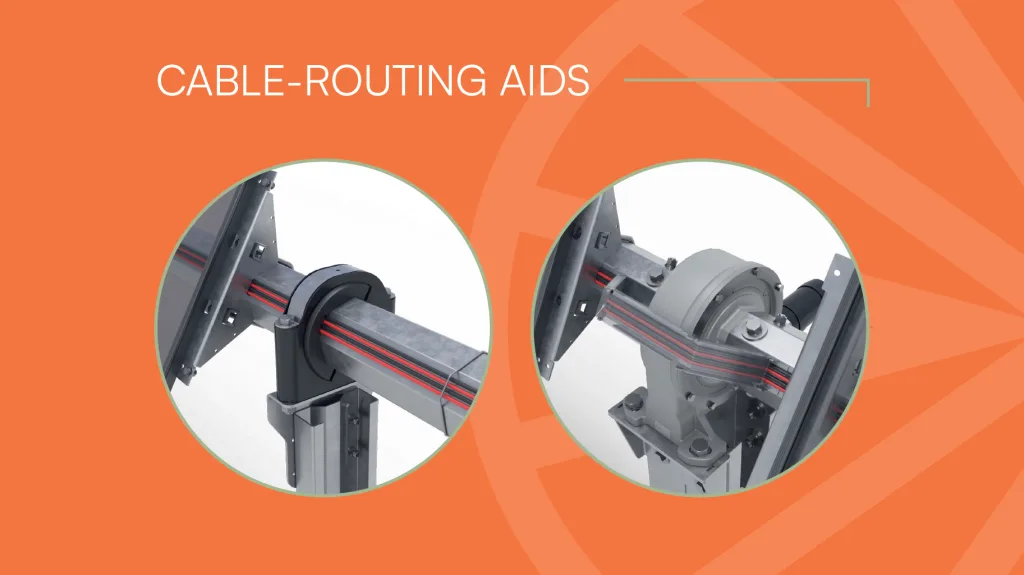
The ENSON Tracker uses integrated cable-routing aids to define and organise the cable path along the structure. These include:
- stainless-steel cable holders;
- dedicated routing points integrated into the tracker;
- cut-outs in the bearing assemblies;
- a cable bridge above the motor.
Together, these features guide cables along the tracker axis and through areas where movement or component interfaces require particular attention.
The purpose is to reduce the risk of cable clashes and damage while giving installation crews a repeatable routing concept.
What integrated cable routing changes on site
For EPC and installation teams, predefined solar tracker cable routing can support:
- consistent cable paths across successive tracker rows;
- less time spent creating individual fixing solutions;
- clearer visual inspection during quality checks;
- reduced contact with edges and moving components;
- more predictable installation sequencing;
- easier identification of deviations from the intended routing.
This is especially relevant in utility-scale PV projects, where the same installation detail is repeated across numerous tracker rows.
Consistency makes it easier to train crews, supervise work and verify that the finished installation follows the approved design.
It can also support future operation and maintenance. Clearly organised cable paths make it easier to inspect the installation and identify irregularities without first having to interpret different routing solutions on individual rows.
Two module mounting options for project-specific installation
Module mounting is another area in which tracker design and site workflow directly interact.
Installation teams may prefer different methods depending on their experience, tools, crew organisation and installation sequence. At the same time, the selected fixing method must remain compatible with:
- the PV module manufacturer’s installation instructions;
- permitted mounting holes or clamping zones;
- calculated project loads;
- the tracker geometry;
- applicable module warranty requirements.
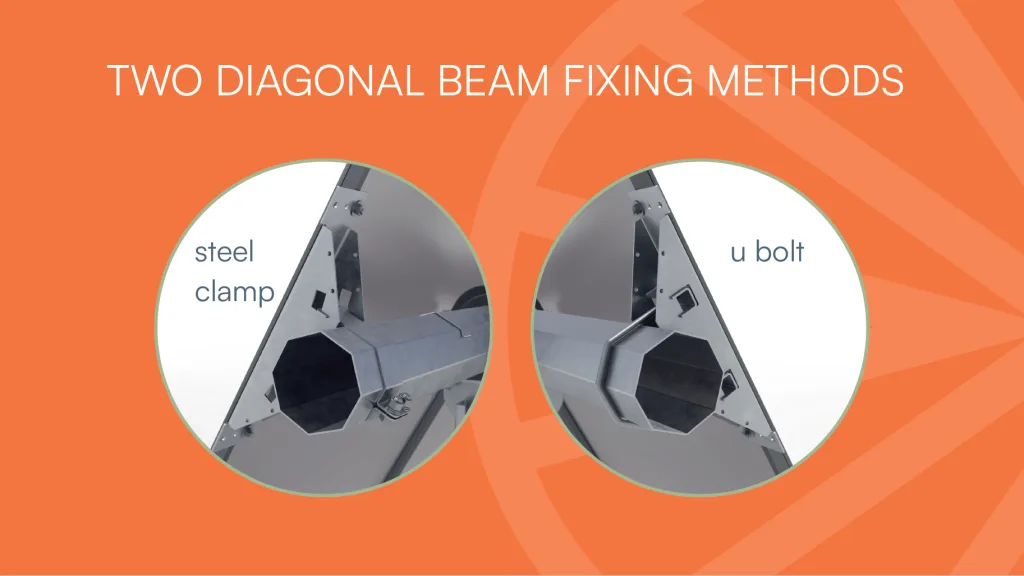
The ENSON Tracker supports two module mounting options:
- bolted fixing;
- clamp fixing.
The method is selected during the project design stage. It is not intended to be chosen freely by the installation crew after construction has begun.
This distinction is important. Flexibility should help adapt the tracker to the project — not transfer engineering responsibility to the job site.
Bolted module fixing
Bolted fixing uses the approved mounting holes in the module frame.
Depending on the selected module and project requirements, this method can provide a clearly defined mechanical connection based on specified fixing points.
The detailed configuration must reflect the module manufacturer’s instructions, the structural calculations and the connection requirements established for the project.
Clamp module fixing
Where permitted by the module manufacturer, clamp fixing can support a fast and repeatable module installation workflow.
The permissible clamping zones, clamp geometry, contact area and tightening requirements must be confirmed before construction. Clamp fixing should never be selected purely because it appears faster on site.
Its use must remain consistent with the approved module installation method, calculated loads and warranty conditions.
Why module fixing should be decided before construction
Leaving key fixing decisions until the construction stage creates unnecessary uncertainty.
It may require crews to adapt their workflow, introduce additional tools, modify installation sequencing or wait for technical clarification while the project is already under schedule pressure.
Defining the solar tracker module fixing method during engineering allows the project team to prepare:
- the correct components and installation tools;
- a clear module installation sequence;
- appropriate torque-control procedures;
- crew instructions and training;
- quality-control checkpoints;
- documentation consistent with the approved design.
Where clamp fixing is permitted and suited to the project, it may support a faster workflow. Where bolted fixing is required or preferred, the tracker can be prepared accordingly.
In both cases, the objective is the same: to align the structural design, module requirements and EPC installation process before work begins on site.
For ENSON, system flexibility does not mean leaving unresolved decisions to the installation team. It means engineering the tracker around the actual project conditions.
Installation efficiency is also a quality issue
Installation-friendly tracker design is often discussed only in terms of labour savings. Its impact is broader.
A clear and repeatable process can:
- reduce variation between tracker rows;
- simplify installation supervision;
- make quality-control points easier to define;
- reduce the risk of assembly errors;
- improve the consistency of handover documentation;
- make subsequent inspections easier.
For utility-scale EPC contractors, this matters because the installation schedule and the quality plan are closely connected.
Accelerating work without controlling repeatability can create defects that are discovered during commissioning or operation. By contrast, a tracker designed around defined cable routes, planned interfaces and project-specific module fixing can support both installation pace and installation quality.
The relevant question is therefore not only:
How quickly can one tracker row be assembled?
It is also:
Can the same approved process be repeated reliably across the entire utility-scale project?
Designing around the real EPC workflow
An efficient tracker installation process begins before components arrive on site.
The structural solution, module interface, cable paths, installation sequence and quality-control requirements should be considered together during engineering.
This allows the EPC contractor to prepare the work rather than resolve fundamental product questions during construction.
For example, the project team should know before mobilisation:
- which module fixing method will be used;
- which tools and torque-control procedures are required;
- how cables should pass through the bearing and motor areas;
- which clearances must be maintained;
- which installation steps require inspection;
- what documentation will be required for acceptance.
The more of these decisions are resolved before construction, the fewer technical uncertainties remain for installation crews.
Designed for real utility-scale project conditions
The structural and mechanical design of the ENSON Tracker was developed in-house and integrated with proven components, including the automation system.
The tracker combines:
- a single-axis, 1V module layout;
- an octagonal torque tube;
- a centrally positioned drive;
- reinforced bearings;
- organised cable routing;
- bolted or clamp module fixing options;
- a structure made predominantly from Magnelis® steel.
These features address different aspects of tracker operation, durability and installation. They were not developed independently of one another.
Cable-routing aids and alternative module mounting methods are not accessories added after the structural concept has been completed. They are examples of how constructability can be incorporated into the tracker itself.
Throughout development, the practical question remained the same:
What will this design mean for a real EPC team, on a real site and under a real project schedule?
What EPC contractors should ask when evaluating a solar tracker
Energy yield, structural performance and wind behaviour remain essential. However, before selecting a tracking system for a utility-scale PV project, EPC contractors and developers should also ask:
- Are the cable paths defined by the tracker design?
- How are cables protected around bearings, motors and moving interfaces?
- Which module mounting methods are available?
- Is the selected fixing method verified against the module manufacturer’s instructions?
- Are the mounting holes or clamping zones clearly defined?
- Which installation decisions are resolved during engineering?
- Which decisions, if any, are left to the site team?
- How repeatable is the assembly process across the project?
- What quality-control points are required during installation?
- How does the supplier support the EPC before and during construction?
The answers indicate whether installation efficiency is a genuine part of the tracker design or simply a claim added to the product specification.
From tracker specification to site performance
A solar tracker’s value is not determined solely by its theoretical energy gain or headline structural parameters. It also depends on how effectively the engineered system can be translated into a consistent installation across the site.
Integrated cable routing helps define how electrical infrastructure interacts with a moving structure.
Project-specific module fixing helps align the tracker with:
- module manufacturer requirements;
- structural calculations;
- installation procedures;
- EPC workflow;
- warranty conditions.
Both reduce the number of unresolved details carried into construction.
For ENSON, installation-oriented engineering means not shifting responsibility to the installation crew, but resolving repeatable site challenges before the first tracker row is assembled.
Planning a utility-scale tracker project?
ENSON designs and manufactures mounting systems and single-axis trackers for utility-scale PV projects.
Our engineering team works with EPC contractors, developers and investors to adapt the structural solution, module interface and installation concept to the requirements of the project.
Explore the ENSON Tracker or talk to our team about your project.